What's Actually in Your Candle? How to Read the Label No One Prints
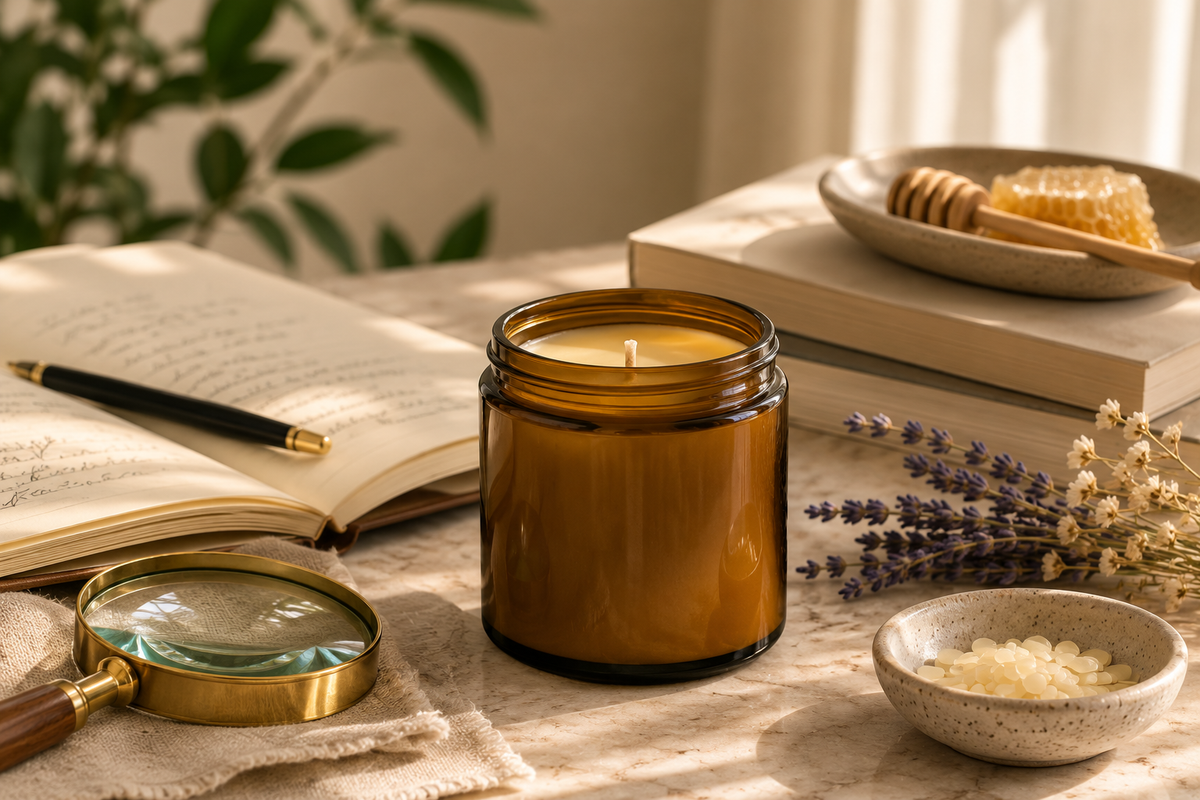
Most candle labels are designed to tell you what the candle is called, how much it weighs, and how to use it safely. They are not always designed to function like the ingredient panel on a packaged food product.
That creates a practical problem for people who care about what they bring into their homes: the front label may say natural, clean, soy, beeswax, or essential oils without telling you enough to understand the full candle.
The solution is not to assume that every missing detail hides something dangerous. It is to learn which questions actually help.
A candle has four basic areas worth understanding: wax, wick, scent, and other additives. Then there is a fifth question that may matter even more: how clearly will the maker explain them?
Start with the wax
Wax is the main fuel in a candle, but the words used to describe it can vary in specificity.
Paraffin tells you that the wax is petroleum-derived.
Soy wax tells you the candle uses a wax derived from soybean oil, but the phrase does not always tell you whether it is the only wax in the formula.
Coconut wax or coconut blend similarly describes a family of candle materials that can be formulated in different ways.
Beeswax tells you the formula includes wax produced by honeybees, but if exact composition matters to you, it is still reasonable to ask whether the candle is entirely beeswax or a blend.
Natural wax blend is much less specific. It may be a perfectly good formula, but the phrase does not tell you what the blend contains.
None of these words alone determines whether a candle is high quality. A wax still needs an appropriate wick, vessel, fragrance system, and burn test.
For a balanced look at the three most familiar materials, read Beeswax vs. Paraffin vs. Soy Wax.
Does “100%” matter?
It matters when you specifically want to know whether a candle uses one wax or a blend.
A wax blend is not automatically inferior. Candle makers blend materials for many reasons, including texture, stability, scent performance, appearance, and burn behavior.
The useful distinction is simply between a product whose composition is important to you and one where you are comfortable with a proprietary blend.
If a product page says only “made with beeswax” or “soy candle” and you care about the ratio, ask the company. A transparent answer is more useful than guessing from the marketing language.
What does “fragrance” mean in a candle?
Fragrance can refer to a formulated aromatic blend rather than one single chemical substance.
A fragrance oil may contain many aroma materials selected to create a particular scent. Depending on the formulation, those materials can be synthetic, naturally derived, or a combination.
That broad formulation palette is why fragrance oils can create scents such as ocean air, amber, linen, baked goods, or highly layered perfume-style compositions that do not exist as a single essential oil.
The word fragrance by itself does not tell you whether the formula is high quality or low quality. It tells you that the scent is a composition and that the complete formula may not be printed on the consumer label.
If scent sourcing matters to you, look for a brand that explains its approach in plain language.
What does “natural fragrance” mean?
“Natural fragrance” can sound more specific than it really is from a shopper's perspective.
Different companies and suppliers may use the phrase under different sourcing standards. It should not be assumed to mean “essential oil only,” and it should not be treated as a universal safety category.
If a candle uses that language and you want more detail, ask what the company means by it. Does the scent come from essential oils? Other naturally derived aromatic materials? A blend?
The answer matters more than the adjective.
What is an essential oil?
An essential oil is a concentrated aromatic mixture derived from plant material. Common candle examples include lavender, eucalyptus, citrus, cedarwood, and peppermint.
Essential oils can make beautiful candles, but “plant-derived” does not mean universally safe, gentle, or appropriate for every household. They are concentrated aromatic substances and still need thoughtful formulation.
Essential oils also do not create every scent people want from home fragrance. That limitation is one reason fragrance oils exist.
Our Essential Oils vs. Fragrance Oils in Candles guide explains the difference without treating one category as morally superior.
What does phthalate-free tell you?
A phthalate-free claim answers one specific formulation question: the fragrance is made without the phthalates covered by that supplier or product standard.
That may be useful information if it aligns with what you want to avoid. It does not describe every aromatic material in the blend and should not be stretched into a claim that the entire candle is universally safe for every person.
Think of it as one data point, not a complete ingredient philosophy.
What does IFRA compliance tell you?
The International Fragrance Association publishes standards that can prohibit, restrict, or specify conditions of use for particular fragrance ingredients.
Compliance can therefore be useful information about how a fragrance is formulated and used within that system.
It does not certify the whole candle. It does not tell you the wax, wick, vessel, or whether a particular person will tolerate the scent comfortably.
A good product page treats fragrance standards as part of formulation rather than a substitute for explaining the candle.
What about the wick?
The wick is a small part of the candle by weight but has an enormous effect on how it burns.
Lead-core wicks are prohibited in U.S. consumer candles. Modern candles commonly use cotton, paper, wood, or other wick constructions.
The material is only half the story. A wick has to be sized for the wax, vessel, and fragrance formula. Too much wick can create a large flame and more soot. Too little wick can create a weak flame or narrow melt pool.
That is why we care less about a marketing phrase such as “premium wick” and more about whether the maker tells you the wick material and whether the finished candle burns with a controlled flame.
Solstice Naturals uses cotton wicks, and our Candle Care guide explains how to maintain them.
Do metal-core wicks automatically mean lead?
No. A metal core is not automatically a lead core.
Because lead-core wicks were a legitimate historical concern, older candle advice sometimes treats any visible wire as evidence of lead. That is not a reliable conclusion for modern U.S. candles.
If wick construction matters to you and the company does not disclose it, ask rather than trying to identify the material visually.
What about dyes?
Dyes and pigments are used to create a particular appearance. They are optional design ingredients, not automatically evidence of a poor candle.
If you prefer minimal formulas or want to see the natural wax color, choosing an undyed candle makes sense. If you enjoy a colored candle, the presence of dye does not tell you whether the wick has been properly sized or the candle well tested.
At Solstice Naturals, we leave the beeswax undyed so natural color variation remains visible.
What about hardeners, stabilizers, and UV additives?
Candle formulas can contain additives that change hardness, surface appearance, color stability, scent performance, or manufacturing behavior.
These ingredients are not automatically “bad.” They are formulation tools.
If your personal preference is a very minimal ingredient list, it is reasonable to choose a maker whose product philosophy matches that preference. But the existence of a stabilizer should not be converted into an unsupported toxicity conclusion simply because its name sounds technical.
Why ingredient transparency still matters
Transparency lets different customers make different choices.
One person may specifically want no added fragrance. Another may prefer essential oils. Someone else may love gourmand and atmospheric fragrance compositions and simply want to know that is what they are buying.
Clear information makes all three choices possible.
That is why our Ingredient Standards distinguish the scent approaches rather than forcing every Solstice candle into the same story.
Pure vs. Artisan at Solstice Naturals
Our Pure Collection is the more botanical scent approach. Depending on the candle, it uses essential oils or no added fragrance.
Our Artisan Collection gives us a broader palette and may use carefully selected fragrance oils or fragrance-and-essential-oil blends when the scent concept calls for them.
Both begin with American beeswax and cotton wicks.
We keep the distinction because “for people who read labels” should mean the customer does not have to reverse-engineer the scent story.
What does “unscented” mean?
Unscented means no fragrance has been intentionally added to create a scent profile. It does not always mean a material has absolutely no smell.
Beeswax naturally has a subtle aroma that some people describe as warm or honey-like. Our Pure Honey candle has no added fragrance, but the wax itself still has sensory character.
This is a good example of why specific language is more useful than assuming every label term means “odorless.”
Can you tell candle quality from a label alone?
No.
A label can help you understand materials, but quality also includes formulation and performance.
A candle can have an ingredient list you love and still be poorly wicked. Another can use a wax you would not personally choose and still be technically well formulated.
Look at the complete product: ingredient disclosure, flame stability, melt-pool behavior, vessel design, care instructions, and the maker's willingness to address problems honestly.
What if the candle has no ingredient list?
Do not assume the worst. Look at the product page, FAQ, or ingredient standards first. If the information is not there, contact the company.
A useful question is specific: “What wax or wax blend do you use, what kind of wick is it, and is the scent made with essential oils, fragrance oils, or a blend?”
That tends to produce a clearer answer than asking whether a candle is “non-toxic.”
Four questions worth asking any candle brand
- What wax or wax blend is used?
- What is the wick made from?
- What creates the scent—essential oils, fragrance oils, a blend, or no added fragrance?
- Are there dyes or other additives you think customers should know about?
If the answers are clear, you can make your own decision based on your preferences instead of outsourcing it to a marketing term.
Questions that are less useful
“Is this candle clean?”
“Is this candle non-toxic?”
“Is this candle all natural?”
Those questions invite broad answers because the words themselves are broad. Ask about the actual product instead.
What should you watch for in health claims?
A candle company should be cautious about promising medical outcomes.
Wax, fragrance, and wick choices can be discussed accurately without claiming that a candle purifies indoor air, detoxifies the home, prevents headaches, treats anxiety, helps a baby sleep safely, or becomes universally appropriate during pregnancy.
If a brand's main ingredient argument depends on a medical or air-cleaning promise, look for evidence that applies specifically to burning that finished candle—not merely to one raw material in another context.
How to read a Solstice Naturals product page
Start with the collection. Pure and Artisan tell you which scent philosophy you are looking at.
Then read the ingredient and scent description. If you want no added fragrance, Pure Honey is the straightforward choice. If you want botanical essential-oil character, Pure is the place to begin. If you want more layered or atmospheric fragrance, Artisan is designed for that.
Finally, check the care information. The candle still has to be burned properly regardless of how simple the ingredient list is.
Frequently asked questions
Does “fragrance” mean something dangerous?
No. It means the scent is a formulated aromatic composition. Different formulations use different materials. If you want more information, ask the maker about its fragrance standards and scent approach.
Does “natural fragrance” mean essential oil?
Not necessarily. Ask what the company means by the term rather than assuming it is equivalent to essential oil.
Are essential oils always better?
No. They offer a botanical scent source but are still concentrated aromatic materials. Fragrance oils allow a broader scent palette. Either can be used thoughtfully.
Should I avoid dyes?
That depends on your preferences. We leave our beeswax undyed, but dye alone does not determine the overall quality of a candle.
How do I know if a candle is actually beeswax?
The most useful evidence is clear disclosure from a trustworthy maker. Color, aroma, or bloom can be consistent with beeswax but are not definitive authentication tests by themselves.
What is the simplest candle formula?
If your goal is to minimize added fragrance, an unscented candle with clearly disclosed wax and wick is the simplest place to start.
The label is the beginning, not the verdict
A good candle label should make it easier to understand what you are buying, but the real standard is transparency across the whole product experience.
Know the wax. Know the wick. Understand the scent source. Ask about additives if they matter to you. Then judge whether the candle actually burns the way a well-made candle should.
That is more useful than trying to find one perfect marketing word.
Read our Ingredient Standards, use the clean candle checklist, or browse all Solstice Naturals candles to compare the current collection.