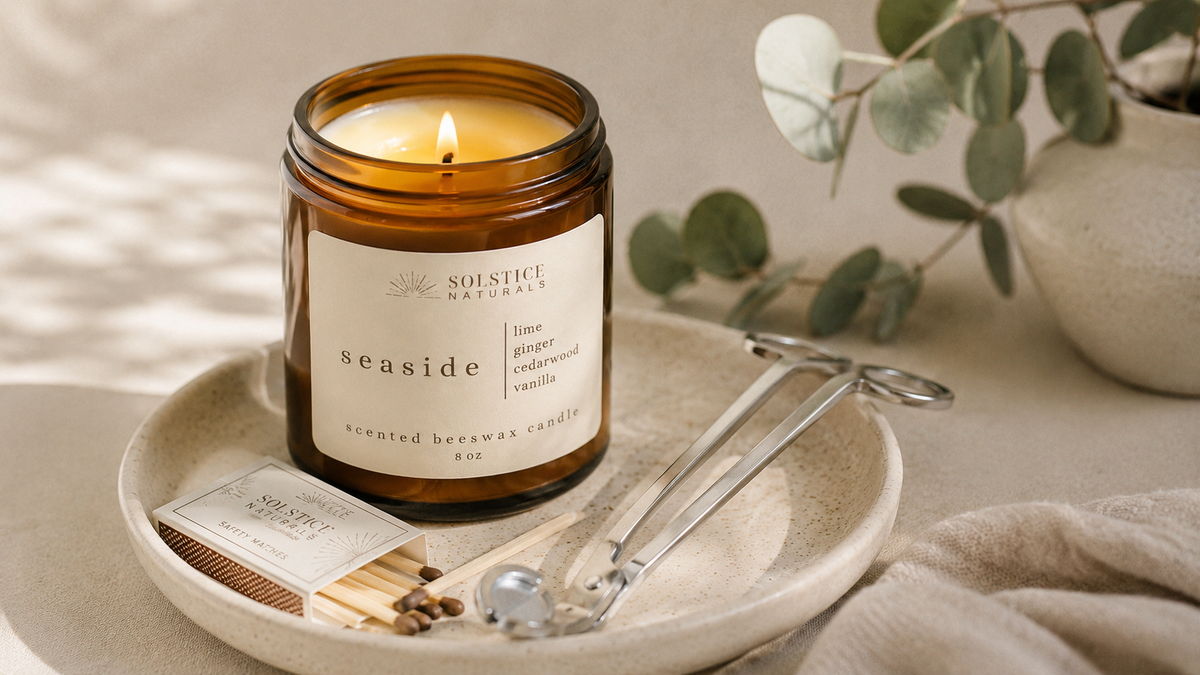
Candle Care

A candle this good deserves to burn properly.

Beeswax behaves differently from most candles. It burns cleaner, slower, and more honestly — and it responds to how it's treated from the very first burn. This guide covers everything.

Section 1

The First Burn

The first burn is the most important thing about a beeswax candle. It sets the pattern for every burn that follows.

The rule: Allow the candle to burn until the melt pool — the pool of liquid wax on the surface — reaches the outer edge of the vessel. For an 8 oz candle, this takes approximately 2 to 3 hours. Do not extinguish it before then.

Why it matters: Beeswax has a higher melting point than paraffin or soy, which means the melt pool develops more slowly. If you extinguish the candle before the melt pool reaches the edges, the wax forms a memory of that boundary. On every subsequent burn, the candle tunnels down the center — a narrow channel forms, the wick drowns in wax on the sides, and the candle's burn life is dramatically shortened.

Tunneling, once established, is very difficult to reverse. A full first burn prevents it entirely.

The simple version: If you don't have 2–3 hours, wait until you do.

Section 2

Wick Care

Our wicks are lead-free cotton, hand-set to the vessel during pouring. Before your first burn, no trimming is needed — trimming too short before the initial burn can prevent the flame from establishing a proper melt pool.

After every subsequent burn: once the candle has cooled completely, trim the blackened tip of the wick to approximately ¼ inch before relighting. A wick trimmer is ideal; small scissors work.

Why it matters:

  • A properly trimmed wick burns steadily and cleanly
  • An untrimmed wick produces a larger, flickering flame with more soot
  • A wick trimmed too short will struggle to sustain a flame in beeswax

¼ inch is the target. Check it every time.

Section 3

Bloom

Raw beeswax sometimes develops a white or chalky surface coating called bloom. This happens when the wax's own natural oils migrate to the surface in response to temperature changes, humidity, or time.

Bloom is completely natural. It has no effect on burn quality, scent, or flame performance. It is, if anything, a reliable indicator of authentic raw beeswax — it occurs because the wax is unprocessed enough to still behave like a natural material.

To remove bloom: warm the surface gently with your hands or a low-heat hairdryer. It will likely return in some environments. That's fine. It's the wax being itself.

Section 4

Scent Expectations

Beeswax burns at a lower temperature than paraffin, which means scent is released more gradually and diffuses more evenly rather than projecting immediately. The room fills over 20–30 minutes rather than in the first moment the candle is lit.

If you're accustomed to synthetic candles, the initial impression will be subtle — sometimes disconcertingly so. This is a calibration issue, not a quality issue. Allow a full burn session (2+ hours, proper melt pool) before evaluating the scent throw.

Customers who make this adjustment consistently describe the experience as: present without being overwhelming, a scent you notice when you leave the room and return to it, a fragrance that fills the space rather than announcing itself.

Once you adjust, most find they don't want to go back.

Artisan Collection note: Our phthalate-free fragrance oils have a somewhat fuller initial throw than our essential oil candles, which some customers prefer. They still build over time rather than peaking immediately.

Section 5

Burn Sessions

We recommend burn sessions of 2–4 hours. Burning longer than 4 hours can cause the wick to become too long, increasing soot and reducing scent performance. It can also make the vessel uncomfortably warm to handle.

Allow the candle to cool completely between sessions — both to harden the wax and to allow the wick to be safely trimmed — before relighting.

Section 6

Safety

  • Never leave a burning candle unattended
  • Keep out of reach of children and pets
  • Burn on a heat-resistant surface away from drafts, curtains, and anything flammable
  • Do not burn in a sealed, unventilated space
  • Extinguish if the flame becomes unusually large or flickers excessively — this indicates a wick that needs trimming

Section 7

When You're Done

When your candle reaches the end of its life, warm the vessel gently to liquefy any remaining wax, pour it out onto newspaper, and wipe the interior with a paper towel. Wash with warm soapy water.

The jar is good glass. Use it.

Unsubscribe anytime. We respect your inbox the same way we respect your home.