Why Beeswax?

The Complete Guide to the Cleanest Candle You Can Burn

If you have ever lit a candle and felt a faint headache creeping in, or noticed a dark film building on the glass, or wondered why the "natural" candle you bought lists "fragrance" as its only scent ingredient — you have already encountered the problem that beeswax solves.

This page is the complete answer to a simple question: why beeswax?

Not the marketing version of the answer. The material one.


What Beeswax Actually Is

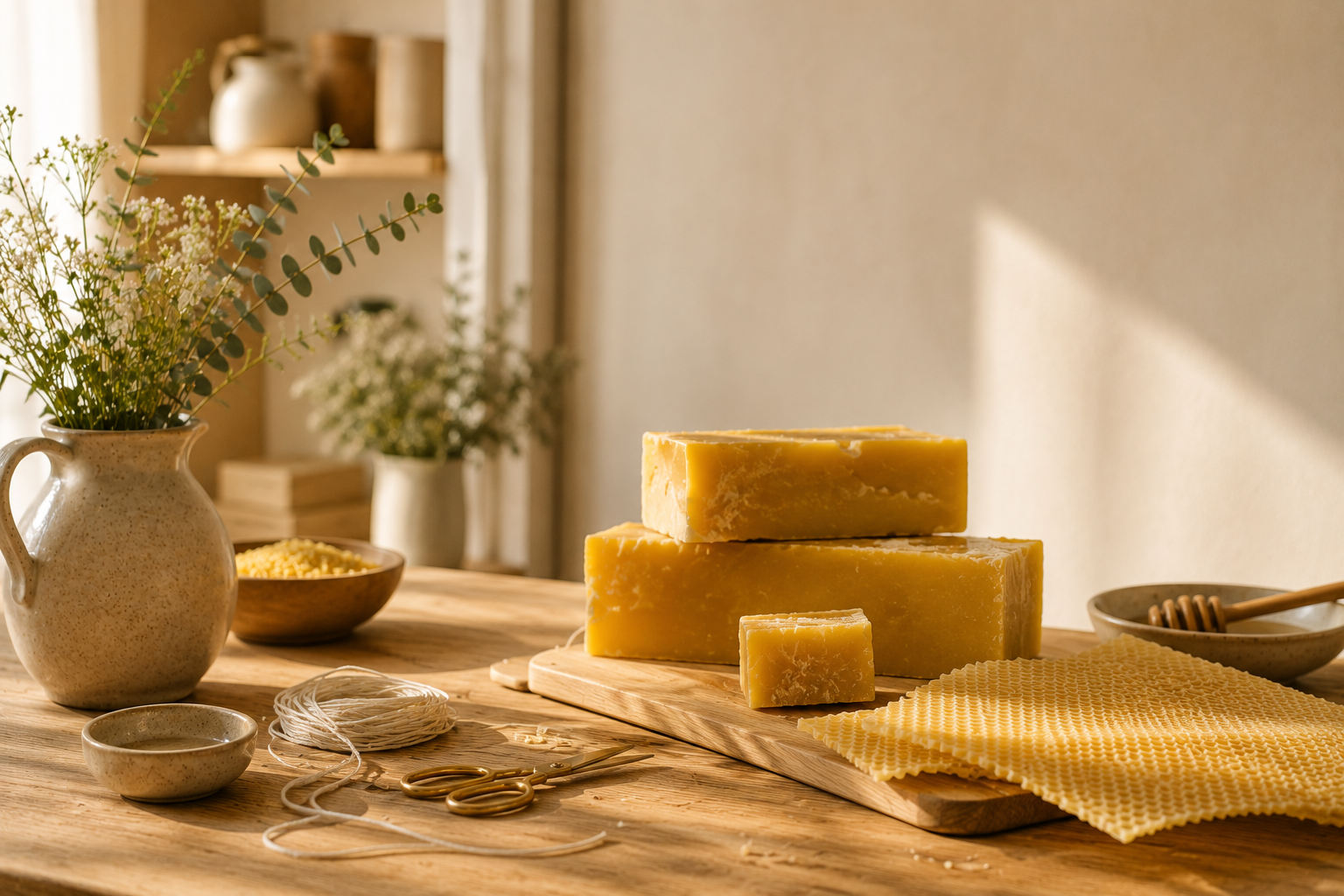
Beeswax is a substance secreted by worker honeybees from glands on their abdomens. They use it to construct the honeycomb — the cells where honey is stored and larvae are raised. When beekeepers harvest honey, beeswax is a co-product: collected from the frames, filtered to remove honeycomb debris, and repurposed for candles, cosmetics, food-grade applications, and dozens of other uses.

This is the complete manufacturing process for beeswax: filter it. No chemical extraction. No solvent processing. No bleaching or deodorizing. No genetic modification of the source material. The wax arrives as it left the hive, cleaned of residue.

This matters because every other commercial candle wax has a longer and more industrial origin story.


How Beeswax Compares to the Alternatives

Paraffin Wax

Paraffin is a byproduct of petroleum refining. When crude oil is processed to produce gasoline and other fuels, paraffin is one of the residual materials — it is then bleached, deodorized, and hardened to various grades before it becomes candle wax.

Paraffin burns and releases combustion byproducts. Research published in peer-reviewed journals has identified benzene and toluene among the compounds released by some paraffin candles under certain conditions. Both are classified as carcinogens by the EPA at sufficient exposure levels. The risk from occasional use in ventilated spaces is low; the concern is regular use in enclosed rooms — a bedroom, a nursery, a home office — where concentration can build over time.

Paraffin also produces visible soot — the black residue on candle jar rims and walls above candle shelves. That soot is fine particulate matter. It is the same class of concern that led many people to stop using indoor wood-burning fireplaces, at a smaller scale.

Bottom line on paraffin: It is the cheapest candle wax available, and the price reflects its origin as an industrial petroleum byproduct. It is not the right wax to burn regularly in a home where air quality matters.


Soy Wax

Soy wax emerged in the 1990s as a paraffin alternative and rapidly earned a reputation for being "natural." That reputation has proven more durable than it deserves.

The GMO question: Approximately 94% of soybeans grown in the United States are genetically modified (USDA data). Most commercial soy wax is derived from these crops.

The hexane extraction process: Soybean oil is extracted from soybeans using hexane, a petrochemical solvent derived from crude oil. Hexane is evaporated during processing, and trace residue in finished soy products is generally considered low-concern. But it does mean that soy wax is not the field-to-candle natural product that its marketing frequently implies.

The paraffin blending problem: Many candles sold as "soy candles" are actually soy-paraffin blends. There is no US regulatory requirement to disclose wax composition on a candle label. A candle can be labeled "made with soy wax" while containing 50% or more paraffin by weight. Unless the label specifies "100% soy wax" — and even then, verification is difficult without transparency from the brand — you may not be buying what you think you are.

Is soy wax bad? Not inherently. 100% soy wax without paraffin blending is a genuine step up from pure paraffin. But the "soy = natural and clean" equation that dominates candle marketing is not accurate in most commercial applications.

Bottom line on soy: Better than paraffin when it is genuinely 100% soy. The "natural" reputation is overstated relative to its actual production process. Frequently blended with paraffin without disclosure.


Beeswax

Beeswax has a higher melting point than either paraffin or soy — approximately 144–147°F compared to paraffin's 99–145°F range. This means several things in practice:

It burns more slowly. The higher melting point means the wax liquefies and is consumed more gradually — producing a longer-lasting candle from the same volume of wax. An 8 oz beeswax candle typically outlasts an 8 oz paraffin candle by a meaningful margin.

It burns with less soot. Because beeswax is not a petroleum product and contains no chemical processing additives, its combustion chemistry is fundamentally different from paraffin. When properly burned — trimmed wick, no drafts, full melt pool — a pure beeswax candle with no synthetic additives produces almost no visible soot.

It has a natural scent. Raw beeswax contains pollen and propolis, which give it a faint, warm, honey-adjacent character. This is the wax's own scent, not a fragrance addition. It is subtle. Some people find it beautiful on its own — which is exactly why our Pure Honey candle contains only beeswax and nothing else.

It does not add petrochemical byproducts to your indoor air. This is the most practically important difference. It does not mean beeswax "purifies" the air — the negative ion claim commonly repeated in beeswax marketing is not supported by peer-reviewed atmospheric chemistry research. What is supported: beeswax combustion does not introduce the same class of petroleum-derived compounds that paraffin combustion does.

Bottom line on beeswax: The most minimally processed candle wax available. Burns longer, cleaner, and without petroleum-derived combustion chemistry. The highest-cost option — because it cannot be manufactured on demand the way petroleum-derived or agricultural waxes can. That cost reflects the material.


A Direct Comparison


Beeswax

Soy Wax

Paraffin

Origin

Honeybee secretion

Soybean oil (often GMO)

Petroleum refining byproduct

Processing

Filtered only — no chemicals

Chemical extraction (hexane)

Bleached, deodorized, chemically altered

Common blending

Rarely blended

Often blended with paraffin

May be blended with other waxes

Burn cleanliness

Cleanest

Cleaner than paraffin (if 100% soy)

Produces petrochemical combustion byproducts

Burn time

Longest per ounce

Moderate

Shortest

Melting point

Highest (~144–147°F)

Moderate (~120–125°F)

Lowest (~99–145°F, varies)

Natural inherent scent

Yes — faint honey warmth

None

None

Disclosure requirements

None (industry gap)

None

None

Renewable

Yes — co-product of beekeeping

Yes — crop-derived

No — petroleum

Price

Highest

Moderate

Lowest


Where Our Beeswax Comes From

We source raw beeswax from small American family apiaries — beekeepers who tend their hives with the kind of direct, personal attention that industrial beekeeping operations cannot provide.

Raw beeswax arrives at our studio in Gainesville, Georgia in blocks. It is filtered twice — gently — to remove honeycomb residue. It is not bleached, not deodorized, not chemically treated between the hive and our studio. The amber color of our candles is the natural color of the wax. The faint honey warmth you smell is its own character.

We source domestically because domestic supply chains are more transparent and more verifiable than international commodity beeswax, where adulteration (blending beeswax with cheaper waxes or paraffin) is difficult to detect without laboratory testing.


The Ingredient Question That Matters More Than the Wax

The wax is the most important ingredient in a candle. But it is not the only one.

A beeswax candle with synthetic fragrance is still releasing synthetic fragrance compounds into your air. A beeswax candle with dyes is still burning dyes. A beeswax candle with a metal-core wick is still releasing metal particulates.

This is why we operate two distinct candle collections:

Pure Collection — beeswax and pure essential oils, or beeswax alone. For the customer who reads every label and wants the shortest possible one."

Artisan Collection — beeswax and phthalate-free fragrance oils, or a mix of essential and fragrance oils, manufactured without carcinogens, mutagens, reproductive toxins, or organ toxins, and IFRA-compliant. For scent profiles that essential oils cannot achieve.

Both collections use the same 100% raw American beeswax. Both disclose every ingredient on every product page. The difference is in the scent source — and we will always tell you which one you are buying.

You can read our complete ingredient standards or browse the full collection with those standards in mind.


Frequently Asked Questions

Is beeswax actually better than soy wax?

In terms of material purity, beeswax is the cleaner starting material by a significant margin. Beeswax requires no chemical processing — it is filtered and used as-is from the hive. Soy wax is extracted from soybeans using hexane (a petrochemical solvent), frequently comes from GMO crops, and is often blended with paraffin without disclosure. 100% soy wax from a transparent brand is a meaningful improvement over paraffin. Raw beeswax requires fewer processing steps and no petrochemical inputs of any kind.

Do beeswax candles really clean the air?

The claim that beeswax candles "clean" or "purify" the air through negative ion release is not supported by peer-reviewed atmospheric chemistry research. Atmospheric chemists at institutions including Colorado State University have stated there is no evidence in the scientific literature for meaningful negative ion emission from burning beeswax candles. What is accurate: beeswax combustion does not introduce petroleum-derived combustion byproducts into indoor air the way paraffin does, and candles without synthetic fragrance produce fewer VOCs than those with synthetic fragrance. We do not repeat the negative ion claim because we cannot defend it.

Why does beeswax cost more?

Raw beeswax costs more than paraffin or soy as a raw material for two fundamental reasons. First, it is a natural co-product of beekeeping — it cannot be manufactured on demand at industrial scale the way petroleum-derived or agricultural waxes can. Second, responsible domestic sourcing from traceable small apiaries costs more than commodity beeswax purchased through international bulk brokers. The price reflects the material and its supply chain.

What is the cleanest candle wax available?

100% raw beeswax is the cleanest commercially available candle wax. It requires no chemical processing beyond filtration, comes from a renewable agricultural source, and burns without the petrochemical combustion byproducts associated with paraffin. Among plant-based alternatives, coconut wax is a reasonable option, and verified 100% soy wax is a step up from paraffin — but neither undergoes as minimal a processing path as beeswax.

How long do beeswax candles burn?

Beeswax candles burn longer than paraffin or soy candles of equivalent size, because beeswax's higher melting point means it liquefies and is consumed more slowly. Our 8 oz candles are rated for 40–50 hours with proper care. Proper care means: a full melt pool on the first burn (2–3 hours), wick trimmed to ¼ inch before each subsequent burn, and burn sessions of 2–4 hours. See our complete Candle Care Guide for the full detail.

Is beeswax sustainable?

Beeswax is a co-product of responsible beekeeping — produced naturally by honeybees and harvested without harming the colony when done properly. Supporting ethical beekeeping operations contributes to pollinator health, which is one of the most consequential environmental priorities of our time. We source domestically from small apiaries because smaller operations are more personally accountable for hive health than industrial beekeeping.

Are beeswax candles safe for nurseries and pregnancy?

A pure beeswax candle with no synthetic fragrance and no added dyes is the cleanest candle formulation available. Our Pure Collection — particularly our Pure Honey unscented candle, which contains only beeswax — is what we recommend for nurseries, during pregnancy, and in fragrance-sensitive households. For Artisan Collection candles, which use a fragrance oil, we recommend consulting with your healthcare provider if you are pregnant or burning candles in spaces with newborns.


Ready to try the cleanest candle we know how to make?

Shop the Pure Collection →

Read our Ingredient Standards →

Unsubscribe anytime. We respect your inbox the same way we respect your home.