Lavender Essential Oil in a Candle: What It Actually Does for Your Home
Lavender is one of the most familiar scents in candles, sleep products, bath products, and wellness spaces. That familiarity creates two opposite problems: some marketing makes lavender sound almost medicinal, while other people dismiss it as a generic “relaxing” fragrance with nothing interesting left to say.
The more useful middle ground is simpler. Lavender essential oil is a real botanical aromatic material with a complex scent profile. Research has explored lavender aromatherapy in several settings, but most of that work does not study burning candles specifically. A lavender candle can be part of an evening ritual and create a sensory environment you enjoy; it should not be presented as a treatment for insomnia, anxiety, or another medical condition.
That distinction matters to us because our Lavender candle uses essential oil for the scent. We want customers to understand what that means without turning the candle into something it is not.
What is lavender essential oil?
Lavender essential oil is an aromatic material obtained from lavender plant material, commonly through steam distillation. It contains many naturally occurring volatile compounds that contribute to the characteristic floral, herbal, and slightly woody aroma associated with lavender.
Different lavender species, growing regions, harvests, and distillation practices can produce oils with noticeably different scent profiles. Some lean sweeter and more floral. Others smell greener, sharper, more camphoraceous, or more herbaceous.
That variability is part of working with botanical materials. “Lavender” is not one perfectly standardized smell.
What does lavender smell like in a candle?
A well-balanced lavender candle should smell recognizably floral and herbal rather than like a vague purple perfume.
In beeswax, the natural warmth of the wax can soften the edges of lavender and give the finished scent more depth. The experience will also change between the cold candle and the candle while burning because heat affects how aromatic compounds reach the air.
Room size, airflow, wick behavior, and fragrance concentration all influence how noticeable the scent becomes. That is why a lavender candle that feels subtle in an open living room may feel much stronger in a small bedroom.
Is lavender proven to help you sleep?
Lavender aromatherapy has been studied in relation to relaxation and sleep, but the evidence needs to be interpreted carefully.
Studies use different populations, methods, doses, products, and delivery systems. Many use inhalation methods such as diffusers, aromatic pads, or controlled exposure—not burning candles. Results from those settings cannot simply be transferred to a candle and turned into a promise that lighting one will make you fall asleep faster.
That does not make the research meaningless. It means the responsible claim is narrower: lavender is commonly associated with relaxing routines, and many people enjoy its scent in the evening. A candle can support that atmosphere without being a sleep treatment.
Can a lavender candle reduce anxiety?
A candle should not be marketed as a treatment for anxiety.
Scent can influence mood, memory, and the feeling of a room, and lavender aromatherapy has been researched in settings involving stress and anxiety. But a consumer candle does not provide a controlled clinical dose, and the experience varies from person to person.
If lavender makes your space feel calmer, that is a valid sensory preference. If you are dealing with persistent or clinical anxiety, professional care is a different category of support and should not be replaced by a home-fragrance product.
Why ritual may matter as much as the scent
One reason candles work so well in evening routines has nothing to do with making a medical claim.
Lighting a candle changes the environment quickly. Overhead lights may go off. The flame creates warmer local light. You may put your phone down, make tea, read, stretch, or sit quietly. Repeating the same sequence can become a familiar transition from the active part of the day into something slower.
Lavender can become part of that cue because scent is strongly tied to memory and association. The useful experience may be the combination of aroma, light, repetition, and reduced stimulation rather than one isolated compound “doing” something to you.
Essential oil vs. lavender fragrance oil
An essential oil and a fragrance oil are different scent tools.
Lavender essential oil comes from plant material and carries the naturally occurring aromatic mixture of that oil. A fragrance oil is a formulated scent composition and may use synthetic, naturally derived, or mixed aromatic materials to create a particular lavender interpretation.
Neither category can be reduced to “real and therapeutic” versus “fake and useless.” A well-made fragrance can smell beautiful, and an essential oil can still be irritating or unpleasant to a particular person.
The important issue is transparency. If a candle is marketed around essential oil, the maker should say so accurately. If it uses a fragrance composition, that should not be disguised as though the scent came entirely from distilling a plant.
Our live guide to Essential Oils vs. Fragrance Oils in Candles explains the distinction in more detail.
Does an essential-oil candle deliver aromatherapy?
We prefer not to use a candle as a stand-in for a controlled aromatherapy treatment.
A candle heats aromatic material in wax while a flame is present. That is a different environment from a diffuser, inhaler, topical product, or research protocol. The amount reaching a person and the chemistry of the surrounding air are not equivalent across those methods.
So our reason for using lavender essential oil is straightforward: we like its botanical scent and the way it fits the Pure Collection. We do not need to promise that the candle delivers a clinical aromatherapy dose.
Why beeswax with lavender?
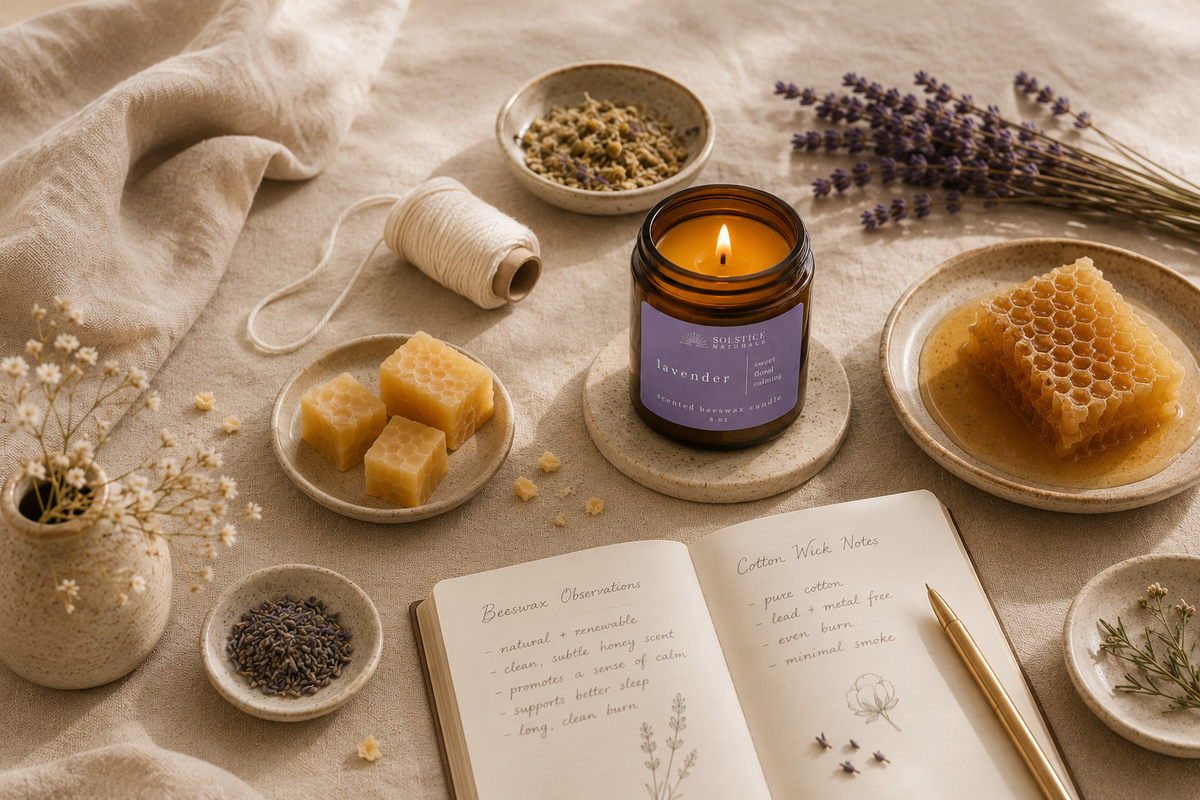
Every Solstice Naturals candle begins with American beeswax. Lavender sits naturally within that material story because the scent stays close to a recognizable botanical profile.
Beeswax also has a faint natural aroma of its own. In a scented candle, that background character becomes part of the finished formula rather than disappearing completely.
We choose beeswax because we value its origin, color, natural variation, aroma, and formulation properties—not because it turns lavender into a medical product.
Our Why Beeswax? page explains the wax choice without relying on air-purification or health promises.
What is in the Solstice Naturals Lavender candle?
Our Lavender candle belongs to the Pure Collection, where the scent approach is intentionally botanical and essential-oil-focused.
We disclose the wax and scent approach because we think customers should be able to distinguish this candle from a lavender fragrance composition in the Artisan style.
For the most current ingredient details and product specifications, use the Lavender product page rather than relying on an old blog post as a substitute for the product label.
Does “pure essential oil” mean universally safe?
No. Essential oils are concentrated aromatic mixtures, and natural origin does not make them universally appropriate for every person or setting.
People can dislike or be sensitive to lavender. Strong fragrance can trigger headaches or discomfort in some individuals. Pets, young children, pregnancy, respiratory conditions, allergies, and other circumstances may create questions that a candle company cannot answer universally.
If a scent causes symptoms, stop using it. If you have a specific health concern, ask the appropriate healthcare professional rather than relying on a blanket “natural equals safe” rule.
Is lavender appropriate in a child's room?
The first issue with any candle in a child's room is the open flame. Never leave a candle burning with a sleeping or unattended child, and keep it completely out of reach and away from fabrics, paper, toys, curtains, and bedding.
For fragrance, we recommend restraint rather than publishing an age cutoff and presenting it as universal medical guidance. If you have questions about essential-oil exposure for a particular child, ask the child's pediatrician.
If you want candlelight without added fragrance, Pure Honey is the simpler option.
How to use a lavender candle as part of an evening routine
Keep the ritual uncomplicated.
- Choose a stable, heat-resistant surface where the candle will remain in sight.
- Lower the brightest room lighting if that helps the space feel quieter.
- Light the candle while you read, take a bath, stretch, journal, or do another low-stimulation activity.
- Keep the flame away from drafts and maintain the wick according to the maker's instructions.
- Extinguish the candle completely before you become drowsy, leave the room, or go to sleep.
The candle should support the routine, not become something you have to monitor anxiously or keep burning until a particular effect occurs.
How long should you burn lavender before bed?
There is no evidence-based candle-specific number that guarantees a sleep benefit.
If you enjoy lavender in the evening, use the candle during the part of your wind-down routine when you are still awake and present. Follow the candle's maximum burn guidance and extinguish it well before sleep.
Safety is more important than trying to copy the exposure time from an aromatherapy study that used a completely different delivery method.
What if lavender gives you a headache?
Extinguish the candle and move to fresh air. Do not assume that because the scent comes from an essential oil your reaction must be unrelated to the fragrance.
Odor sensitivity is individual. Essential oils and fragrance oils can both be triggers for some people, and a small enclosed room can make any scent feel more intense.
Our live article Candle Headaches: Why Some Candles Make You Feel Sick offers a more balanced troubleshooting approach.
Does stronger lavender mean better lavender?
No.
Scent intensity is not a quality test. An extremely strong candle may simply use a different concentration, aromatic material, wick, vessel, or formula. A subtler candle may be exactly right for a smaller room or someone who prefers restrained home fragrance.
Quality is better judged by transparency, formulation, stable burn behavior, and whether the fragrance smells intentional rather than by how quickly it fills the largest possible space.
Why not make every lavender candle with essential oil?
Essential oil is one valid way to create a lavender scent, but it is not the only legitimate approach.
A perfumer may use a fragrance composition to create a lavender scent with added woods, musk, vanilla, herbs, or other facets that do not exist in one bottle of essential oil. That can be a beautiful creative choice when it is described honestly.
Our own Lavender candle stays in the Pure Collection because we want that product to feel close to the botanical material itself.
What should you look for in a lavender candle?
Look beyond the word lavender.
- What wax is used?
- Is the scent source identified?
- Does the product use essential oil, fragrance oil, or a blend?
- Is the wick material disclosed?
- Does the brand provide practical care guidance?
- Does the marketing promise a pleasant scent and atmosphere, or does it drift into treating medical conditions?
Those questions tell you more than whether the front label uses words such as “calming,” “natural,” or “wellness.”
Frequently asked questions
Does a lavender candle help you sleep?
It may be a pleasant part of a bedtime routine, but a candle should not be presented as a proven treatment for insomnia. Lavender aromatherapy has been studied in other delivery formats, and those results cannot simply be converted into a candle-specific guarantee.
Can lavender candles help with anxiety?
A lavender scent may feel calming to some people, but a candle is not an anxiety treatment. Persistent or clinical anxiety deserves appropriate professional care.
Is lavender essential oil better than lavender fragrance oil?
They are different tools. Essential oil offers a botanical aromatic profile; fragrance oil can create a wider range of lavender interpretations. Quality depends on the formulation and transparency, not on treating one category as universally superior.
Is lavender essential oil safe for everyone?
No aromatic material is universally comfortable or appropriate for everyone. Stop using a scent that causes symptoms and seek individualized advice when a specific health concern exists.
Can I leave a lavender candle burning while I sleep?
No. Never leave any candle burning while you sleep or when the room is unattended.
What if I want no added fragrance at night?
Choose an unscented candle. Pure Honey contains no added fragrance and allows the natural character of beeswax to remain the main sensory element.
Lavender does not need exaggerated claims to be worthwhile
The strongest case for a lavender candle is not that it acts like medication. It is that lavender is a beautiful botanical scent with a long cultural association with rest, bathing, linens, gardens, and evening rituals.
When you enjoy the aroma, it can help make a room feel like the kind of place where you want to slow down. That is a meaningful experience without turning a candle into a therapeutic device.
Explore the Solstice Naturals Lavender candle, browse the botanical Pure Collection, or review our Ingredient Standards for more about how we think about scent and transparency.