Candles During Pregnancy: What to Know Before You Light One
Pregnancy often leads people to look more closely at the products they use at home, including candles. The challenge is that candle advice online tends to swing between two extremes: “all candles are toxic” and “there is nothing to think about.” Neither is very useful.
A candle is a small indoor combustion source. If it is scented, it also releases aromatic compounds as the wax warms. That does not make occasional candle use automatically unsafe during pregnancy, and it does not make one wax or fragrance category universally “pregnancy safe.”
The sensible approach is to reduce unnecessary exposure, use candles conservatively, keep the flame well maintained, ventilate appropriately, and ask your prenatal healthcare professional about any specific ingredient or medical concern.
Are candles safe during pregnancy?
There is no single answer that applies to every candle, room, pregnancy, or person. Exposure depends on the product, how long it burns, the size and ventilation of the room, whether the flame is smoking, and whether the person using it is sensitive to fragrance.
If a candle makes you nauseated, gives you a headache, irritates your eyes or throat, or otherwise makes you uncomfortable, extinguish it. Pregnancy can change scent perception dramatically, and there is no benefit in pushing through a fragrance you no longer tolerate.
Start with fire safety
Pregnancy-specific ingredient questions do not replace ordinary candle safety. Keep candles on stable, heat-resistant surfaces, away from drafts and anything combustible, and within sight whenever they are lit.
Never fall asleep with a candle burning. If you are tired, leave the room, or begin a task that will pull your attention away, extinguish it first.
Our Candle Care guide covers wick maintenance and general burn practices.
What about candle fragrance during pregnancy?
Fragrance is personal, and pregnancy can make previously pleasant scents feel overwhelming. If you prefer to minimize variables, choosing an unscented candle is the simplest option.
That does not mean every fragrance oil is dangerous or every essential oil is safe. Essential oils are concentrated aromatic mixtures, while fragrance oils are formulated scent systems that may contain synthetic, naturally derived, or mixed aromatic materials.
Safety depends on the specific substances, concentration, product formulation, and exposure—not simply whether an ingredient is labeled “natural.”
Our Ingredient Standards explain how Solstice Naturals distinguishes essential oils, fragrance oils, fragrance-and-essential-oil blends, and unscented candles.
Should you avoid specific essential oils while pregnant?
We do not think a candle company should publish a universal trimester-by-trimester list of essential oils and present it as medical guidance. Different oils, concentrations, routes of exposure, and individual health histories matter.
If you have been advised to avoid a particular essential oil, check the candle's scent information or contact the maker before using it. If you are unsure whether a specific aromatic material is appropriate for you, ask your OB, midwife, or other qualified prenatal healthcare professional.
Ingredient origin alone is not a complete safety assessment, which is why we prefer specific scent-source disclosure over blanket “natural equals safe” claims.
What about paraffin, soy, and beeswax?
Wax type is only one part of candle performance. Wick size, vessel design, fragrance, drafts, maintenance, and ventilation can all influence emissions and soot.
You may see claims that paraffin is automatically dangerous in pregnancy or that beeswax is automatically the “safest” wax. Those claims are too broad. A burning candle of any wax type is still a combustion source, and a poorly maintained flame can smoke or soot.
Solstice Naturals uses American beeswax because we value its material character, subtle aroma, higher melting point, and performance in our formulations. We do not position beeswax as a medical safeguard for pregnancy.
For a fuller material comparison, see Beeswax vs. Paraffin vs. Soy Wax.
Why an unscented candle can be the easiest choice
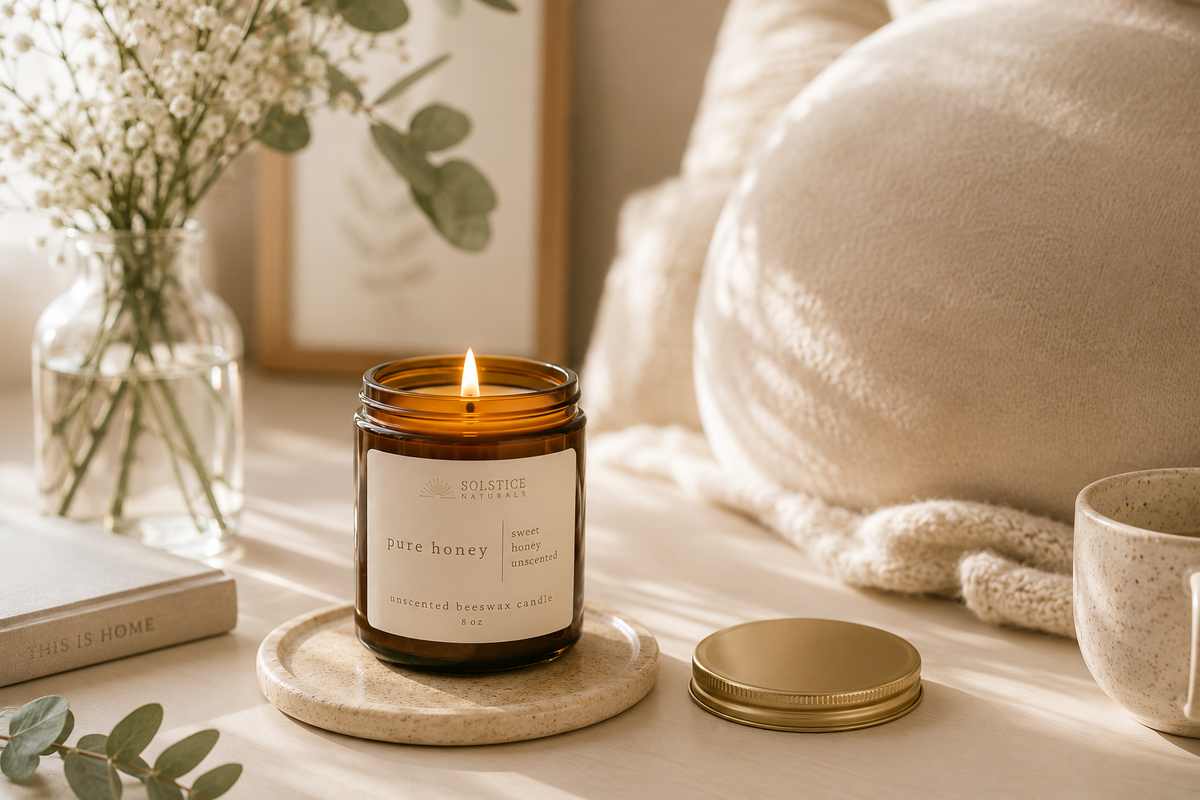
If you want candlelight but would rather avoid added fragrance, Solstice Naturals Pure Honey contains no added essential oil or fragrance oil.
Its faint warm, honey-like aroma is the natural character of beeswax, not an added honey scent. Because there is no intentional fragrance system, it removes one variable for people whose sense of smell has become especially sensitive.
It is still a candle and should still be used with the same ventilation, supervision, and fire-safety practices as any other candle.
Can you use scented candles if they do not bother you?
If you choose to use a scented candle during pregnancy, keep the setup simple. Use one candle at a time, avoid a very small sealed room, maintain the wick, and stop if the scent becomes uncomfortable.
There is no need to burn a candle for hours simply to make a room smell stronger. A shorter attended session may be more comfortable, particularly if pregnancy has made you more sensitive to scent.
Ventilation matters—but avoid direct drafts
Reasonable fresh-air exchange can help prevent fragrance and combustion byproducts from accumulating in a small space. At the same time, do not put a candle directly in front of an open window, fan, or HVAC vent. Moving air can destabilize the flame and increase soot.
Think about room-level ventilation rather than blowing air directly across the candle.
What about a candle in the nursery while pregnant?
If you are setting up a nursery and want candlelight while working in the room, keep the flame fully supervised and extinguish it before leaving or before the room becomes a sleep space.
Once a baby is using the room, the most important issue is the open flame itself. Our live guide to candles in a nursery focuses on supervision, fragrance restraint, placement, and extinguishing before sleep.
What if fragrance gives you a headache or nausea?
Extinguish the candle and move to fresh air. Do not assume that switching automatically from fragrance oil to essential oil will solve the issue; either type of aromatic material can be uncomfortable for a sensitive person.
Our article Candle Headaches: Why Some Candles Make You Feel Sick explains fragrance sensitivity, smoke, soot, and ventilation without treating one ingredient category as the universal cause.
Practical pregnancy candle checklist
- Use candles only while awake and present.
- Keep the flame away from curtains, bedding, paper, pets, and children.
- Maintain the wick according to the maker's instructions.
- Extinguish any candle that is smoking continuously or developing an unusually large flame.
- Use reasonable room ventilation without placing the flame in a direct draft.
- Avoid layering several scented products in a small space.
- Choose unscented if pregnancy has made fragrance unpleasant.
- Stop using any candle that consistently causes symptoms.
- Ask your prenatal healthcare professional about specific ingredient concerns rather than relying on blanket online lists.
Frequently asked questions
What candle is safest during pregnancy?
No candle can be declared universally safest based on wax type alone. If you want to minimize variables, an unscented candle removes added fragrance. Regardless of the wax, use it with proper wick care, supervision, and ventilation.
Can I burn an essential-oil candle while pregnant?
Essential oils are not automatically appropriate or inappropriate during pregnancy as a category. If you have questions about a specific oil, concentration, or medical circumstance, ask your prenatal healthcare professional.
Are fragrance oils unsafe during pregnancy?
It is too broad to treat all fragrance oils as one ingredient. Formulations vary. If fragrance itself makes you uncomfortable, choose unscented. If you have a specific safety concern, ask the maker for information about the fragrance system and discuss the issue with your healthcare professional.
Does a phthalate-free claim mean a candle is pregnancy safe?
No single marketing claim can establish that. “Phthalate-free” describes one aspect of a fragrance formulation; it does not replace consideration of the entire product, exposure, and individual sensitivity.
Should I stop using candles entirely during pregnancy?
Not necessarily. Many people choose to continue occasional candle use. If you do, keep the flame supervised, maintain good burn conditions, use reasonable ventilation, and choose fragrance intensity based on what feels comfortable to you.
A more useful standard than “pregnancy safe”
Pregnancy is a good reason to be thoughtful, but it is not a reason for a candle company to make medical promises.
Choose transparent products. Use fewer scented products rather than more. Keep the flame clean and controlled. Ventilate appropriately. Choose no added fragrance if that feels better. And bring specific medical questions to the professional who knows your pregnancy.
If you prefer a candle with no added fragrance, explore Pure Honey. For the full Solstice ingredient philosophy, see our Ingredient Standards.